

By Stacker
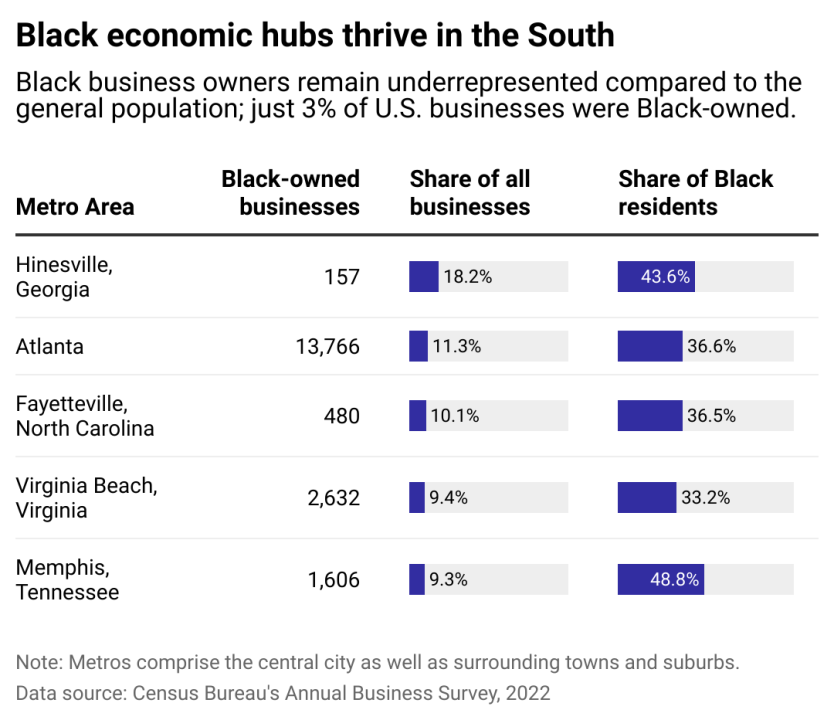
- Black-owned businesses thrive in Southern states like Georgia that leads with 18.2% of companies being Black-owned
- The Greenwood District in Tulsa flourished with over 100 Black-owned businesses from restaurants and grocery stores to hotels and hospitals
In the early 1900s, the Greenwood District flourished with over 100 Black-owned businesses, from restaurants and grocery stores to hotels and hospitals. Greenwood’s prosperity came to a violent end in 1921 when a white mob destroyed the district in what is now known as the Tulsa Race Massacre. Though perhaps the most widely known, Tulsa’s story was not unique. Stacker used Census data and other sources to explore the untold history of lesser known Black Wall Streets across the U.S. and how present day Black business districts strive to rebuild wealth and opportunity in the current economic landscape.
Legacy of Black business Districts Across America
The Greenwood district’s success represented more than just commerce; it embodied Black Americans’ resilience and ingenuity in creating economic opportunities despite the crushing restrictions of Jim Crow laws. However, in just two days, their ensuing violence left 35 city blocks decimated, over 800 people injured, potentially 100 to 300 people killed (though exact figures can never be determined), and generations of accumulated wealth erased.
Across America, Black entrepreneurs established thriving business districts that faced similar threats from racial violence and discriminatory policies. From Richmond’s Jackson Ward, known as “the cradle of Black capitalism,” to Detroit’s Paradise Valley, Chicago’s Bronzeville, and Atlanta’s Sweet Auburn, across America, Black entrepreneurs established communities with flourishing enterprises that stood as beacons of economic promise and prosperity.
Ongoing Wealth Gap
The dismantling of these Black business districts has had lasting effects on economic progress for Black Americans spanning generations. According to the American Civil Liberties Union’s 2023 Visualizing the Racial Wealth Gap report, the gap in wealth between Black and white families has only grown since the 1970s. In 2018, the median white family of three earned $33,000 more than a Black family of the same size. Black homeownership rates have also stagnated, lagging behind Hispanic homeownership rates and never reaching the 50% mark in the last 10 years.
Collective Economics: Building Black Business Districts Today
Today’s landscape shows both progress and persistent challenges. Census data reveals that while Black Americans represented about 12% of the population, they owned just 2.4% of American small businesses in 2020.
However, data suggests that Black-owned businesses thrive in Southern states. Hinesville, Georgia, leads with 18.2% of companies being Black-owned despite its population only being slightly above 35,000. On the other hand, Atlanta, a larger city with more than 500,000 residents, maintains a strong presence, with 13,766 Black-owned businesses representing 11.3% of all enterprises.
Cities like Memphis, Tennessee, also have a notable presence of Black businesses. The city, which hosts more than 600,000 residents, has a Black population comprising 48.8% of residents, and Black-owned companies comprise 9.3% of all enterprises.
The resurgence of modern Black business districts in these cities is driven by strong entrepreneurial ecosystems supporting emerging and established businesses. From local policies to entrepreneur networks, dedicated efforts are shaping sustainable ecosystems that empower Black entrepreneurs and fuel long-term success.
Challenges in accessing capital
Access to capital remains a significant barrier for Black entrepreneurs. According to the Federal Reserve’s 2022 Small Business Credit Survey, Black-owned firms are twice as likely to be denied business loans as white-owned firms. The Census Bureau’s 2022 Annual Business Survey also found that Black-owned firms were less likely to receive the full financing they sought than white-owned firms. Specifically, fewer than 2 in 5 (38.4%) Black-owned firms received all the funding they applied for, while 3 in 5 (62.3%) white-owned firms experienced the same outcome.
The venture capital landscape reflects similar disparities. In 2023, Black-founded startups in the U.S. received approximately $661 million in venture capital funding, representing just 0.48% of the total $136 billion allocated that year and 1.4% of total U.S. venture funding, TechCrunch reported. This marks a substantial decline from 2021, when Black founders secured nearly $5 billion, according to Crunchbase. The downturn of financing is more pronounced in certain regions. For instance, in Atlanta, Crunchbase reported investments in Black-owned startups dropped from $467 million in 2021 to just $23 million in 2023.
While the challenges remain significant, today’s Black entrepreneurs are building on their predecessors’ legacy of resilience and innovation, working to close the racial wealth gap one business at a time.
CBX Vibe: “The Glory” JID